April 2011
Edited by Tina & Dennis Homes
GROOMING TIPS FROM THE PARLOUR – Anal Glands
My dog keeps dragging its bottom along the floor. Has it got worms? The answer could well be yes, or it could just have an itchy bottom, or be suffering neurological problems or most likely that the anal glands need emptying.
It’s quite a comical sight to see a dog pulling themselves along by their front legs and their bottoms dragging along as though on castors. All the dog is trying to do is to self evacuate and relieve the itchiness. You might also notice that your dog lick the area just below the tail set, as well as bite itself along the tail root and sometimes on and around the rump area.
So what are anal glands? These are two small sacs which sit alongside the rectal wall, just about 25mm inside the anus. If you were to look at the rear of your dog these glands are placed at 40 – 20 positions on a clock face either side of the anus. Each sac contains a fluid which can be anything from cream in colour to dark brown with a very offensive odour. When the dog defecates a small amount of this fluid will coat the stools as they pass out. It is thought that anal glands are a relic of the past when wild dogs would use these scent markers so that other pack members would recognise each other. Should you see your dog doing any of the actions mentioned above, it is advisable that you seek to have these glands examined.
As a groomer I was trained how to do this, both externally and internally, but it is not an exercise I would recommend to anyone without first being shown and taught the correct method. Any mishandling can create disastrous results with either rectal wall damage or tearing of the sacs.
Should you not follow through with a visit to either your Veterinary Surgeon or trained groomer to express these glands, the once liquid contents can become more paste like even resembling the consistency of pate. The gland (only one gland will do this at a time) will become blocked. It will distend and infection sets up. The sac will abscess which will become first red and then later turns a deep purple colour it can at this point rupture. A smelly bloody and pus like discharge will drain out; your dog will become uncomfortable and be in some pain constantly licking the area. You should seek professional assistance with your Veterinarian immediately. Sometimes your Vet will clean out the abscess and this is usually done under sedation and will administer oral antibiotics. Healing will take place quite quickly.
Anal gland impaction is not a rarity, and some dogs are more prone to this problem than others. Once your dog has suffered impaction it may be good practice to attend your Vet with advice on changing your dog’s diet to something with a little more bulk. This in turn will add more roughage to its stools and so avoid a recurrence. However should you dog have several gland infections some Vets will recommend the removal of these glands.
My dog keeps dragging its bottom along the floor. Has it got worms? The answer could well be yes, or it could just have an itchy bottom, or be suffering neurological problems or most likely that the anal glands need emptying.
It’s quite a comical sight to see a dog pulling themselves along by their front legs and their bottoms dragging along as though on castors. All the dog is trying to do is to self evacuate and relieve the itchiness. You might also notice that your dog lick the area just below the tail set, as well as bite itself along the tail root and sometimes on and around the rump area.
So what are anal glands? These are two small sacs which sit alongside the rectal wall, just about 25mm inside the anus. If you were to look at the rear of your dog these glands are placed at 40 – 20 positions on a clock face either side of the anus. Each sac contains a fluid which can be anything from cream in colour to dark brown with a very offensive odour. When the dog defecates a small amount of this fluid will coat the stools as they pass out. It is thought that anal glands are a relic of the past when wild dogs would use these scent markers so that other pack members would recognise each other. Should you see your dog doing any of the actions mentioned above, it is advisable that you seek to have these glands examined.
As a groomer I was trained how to do this, both externally and internally, but it is not an exercise I would recommend to anyone without first being shown and taught the correct method. Any mishandling can create disastrous results with either rectal wall damage or tearing of the sacs.
Should you not follow through with a visit to either your Veterinary Surgeon or trained groomer to express these glands, the once liquid contents can become more paste like even resembling the consistency of pate. The gland (only one gland will do this at a time) will become blocked. It will distend and infection sets up. The sac will abscess which will become first red and then later turns a deep purple colour it can at this point rupture. A smelly bloody and pus like discharge will drain out; your dog will become uncomfortable and be in some pain constantly licking the area. You should seek professional assistance with your Veterinarian immediately. Sometimes your Vet will clean out the abscess and this is usually done under sedation and will administer oral antibiotics. Healing will take place quite quickly.
Anal gland impaction is not a rarity, and some dogs are more prone to this problem than others. Once your dog has suffered impaction it may be good practice to attend your Vet with advice on changing your dog’s diet to something with a little more bulk. This in turn will add more roughage to its stools and so avoid a recurrence. However should you dog have several gland infections some Vets will recommend the removal of these glands.
THE CAVALIER IN ART OVER THE CENTURIES – (Part 4) Rubies
In a number of books and articles it has often been stated that ruby toy spaniels did not emerge until the early part of the nineteenth century. This assumption was probably based on the fact that in many of the old masters it is only blenheims, tricolours and black and tans that are depicted in these paintings. It was assumed that rubies appeared due to out-crossing with another breed or by mutation. However there are a few paintings around that show that rubies have been around for a very long time. In the National Gallery in London there is a large painting by the Italian artiste Pisanello called The Vision of Saint Eustace. It shows a St Eustace hunting on horseback with a pack of dogs including greyhound types. At the very bottom of the painting, running alongside the horse, are two small spaniel type dogs that are ruby red in colour. This was painted in 1438 and below is a detail from that painting.
In a number of books and articles it has often been stated that ruby toy spaniels did not emerge until the early part of the nineteenth century. This assumption was probably based on the fact that in many of the old masters it is only blenheims, tricolours and black and tans that are depicted in these paintings. It was assumed that rubies appeared due to out-crossing with another breed or by mutation. However there are a few paintings around that show that rubies have been around for a very long time. In the National Gallery in London there is a large painting by the Italian artiste Pisanello called The Vision of Saint Eustace. It shows a St Eustace hunting on horseback with a pack of dogs including greyhound types. At the very bottom of the painting, running alongside the horse, are two small spaniel type dogs that are ruby red in colour. This was painted in 1438 and below is a detail from that painting.

The picture below was painted around 1550 by Steven van der Muelen and is believed to be spaniel owned by Lady Knollys a first cousin, (albeit illegitimately), of Queen Elizabeth I.


Above is a ruby in a very typical pose painted by C. Fulton in the mid nineteenth century.

A longer nosed ruby with a more flatter faced tricolour painted by Samuel Bough in 1850. It was around this period when the fashion for short faced toy dogs emerged and there was indeed out crossing to flat faced oriental breeds. This how the King Charles Spaniel came about.

Another painting from the mid 1800s, this time by the Dutch artist Bernard de Gempt.
THE ROYAL WEDDING
As this month sees the royal wedding of Prince William and Kate Middleton we thought that it would be appropriate to focus on the Royal Family’s association with Cavaliers. Although the obvious link between Cavaliers and the Royal Family is with Charles II, from where the name Cavalier King Charles is derived, small toy spaniels were associated with the monarchy very much earlier. Mary Queen of Scots famously had a small tricolour hiding under her clothing when she was executed. It is believed that she brought this tricolour over from France. Queen Mary I of England, who was married to Philip II of Spain, is also depicted in a painting with her husband and two very small blenheim spaniels by their feet.
With the House of Stuart Charles I married Henrietta of France. The French Royal family had also been known have kept toy spaniels and it is believed that Henrietta brought some to England from France. This is probably how the Stuarts first associated themselves with small spaniels. Below is a painting of Henrietta playing a lute and with a spaniel at her feet who appears to disapprove of her musical abilities!
As this month sees the royal wedding of Prince William and Kate Middleton we thought that it would be appropriate to focus on the Royal Family’s association with Cavaliers. Although the obvious link between Cavaliers and the Royal Family is with Charles II, from where the name Cavalier King Charles is derived, small toy spaniels were associated with the monarchy very much earlier. Mary Queen of Scots famously had a small tricolour hiding under her clothing when she was executed. It is believed that she brought this tricolour over from France. Queen Mary I of England, who was married to Philip II of Spain, is also depicted in a painting with her husband and two very small blenheim spaniels by their feet.
With the House of Stuart Charles I married Henrietta of France. The French Royal family had also been known have kept toy spaniels and it is believed that Henrietta brought some to England from France. This is probably how the Stuarts first associated themselves with small spaniels. Below is a painting of Henrietta playing a lute and with a spaniel at her feet who appears to disapprove of her musical abilities!


Above are the children of Charles I, which includes a young Charles II who would give his name to the breed.
Charles II had no legitimate heirs, although he had at least twelve illegitimate offspring. He was therefore succeeded to the throne by his younger brother James II. James was also a great lover of small spaniels but sadly we cannot find any paintings of his dogs. Oddly enough there are not a great many paintings of James II as compared to other monarchs, (perhaps he was canvas shy!).
With the House of Hanover there was another monarch who kept many Cavalier type spaniels and this was George III. He indeed had quite a few but this is rarely mentioned in books about Cavaliers and King Charles Spaniels.
With the House of Hanover there was another monarch who kept many Cavalier type spaniels and this was George III. He indeed had quite a few but this is rarely mentioned in books about Cavaliers and King Charles Spaniels.
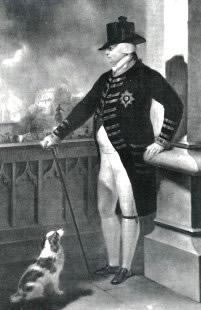

Above left is George III with his spaniel and right is his wife Queen Charlotte with her small dog.

These are the children of George III and Queen Charlotte with their spaniels.
Queen Victoria’s Spaniels
Queen Victoria was a great lover of animals and throughout her long life had owned a great many dogs. Much has been written about her devoted tricolour named Dash, but she also had at least three other Cavalier type spaniels as can be seen in the paintings below.
Queen Victoria was a great lover of animals and throughout her long life had owned a great many dogs. Much has been written about her devoted tricolour named Dash, but she also had at least three other Cavalier type spaniels as can be seen in the paintings below.


Above left is a very young Victoria holding a Blenheim spaniel and right is a painting of her much beloved Dash.

Another painting of Dash with two of Victoria’s other dogs and her parrot.

This is from an etching of Queen Victoria with two of her young children plus a small Blenheim spaniel.

As well as blenheims and a tricolour the Queen also had a black and tan which is seen here with Islay the terrier and the Queen’s birds.
The last member of the Royal Family to own a Cavalier was Princess Margaret. She is seen below with The Earl of Snowdon and her Blenheim Cavalier Rowley.

EASTER TREATS
With Easter fast approaching many children will be receiving Easter eggs and quite a lot of children like to treat their pets on these special occasions. But please do not be tempted to give your dog chocolate that is made for human consumption because chocolates contains theobromine, a stimulant that is found in the cocoa bean and it can be harmful to dogs. It can cause vomiting and restlessness in pets and in larger doses can prove fatal. While most dog owners may expect their pet to develop an upset stomach after eating a large amount of chocolate, few realize its danger or toxic potential. The lethal dose of theobromine depends on the size of the dog and the type of chocolate. Ounce for ounce, baking chocolate has six to nine times as much of the substance as milk chocolate does. Because dogs are given choc drops that are sold in most pet shops people tend to think that chocolate is harmless to dogs. However dog choc drops do not contain theobromine and are indeed a useful treat when training a dog. We’ve heard many people say that they often give their dogs pieces of chocolate without having any adverse effects but it all depends on the type of chocolate, how much is given and the size of the dog. As a general rule it is best to only give chocolate made especially for dogs. There are some ‘doggy’ Easter eggs available at large pet stores. Both Good Boy and Hatchell have some on the market this year. Hatchell also have dog hot cross buns on sale if you really want to spoil your pet.
With Easter fast approaching many children will be receiving Easter eggs and quite a lot of children like to treat their pets on these special occasions. But please do not be tempted to give your dog chocolate that is made for human consumption because chocolates contains theobromine, a stimulant that is found in the cocoa bean and it can be harmful to dogs. It can cause vomiting and restlessness in pets and in larger doses can prove fatal. While most dog owners may expect their pet to develop an upset stomach after eating a large amount of chocolate, few realize its danger or toxic potential. The lethal dose of theobromine depends on the size of the dog and the type of chocolate. Ounce for ounce, baking chocolate has six to nine times as much of the substance as milk chocolate does. Because dogs are given choc drops that are sold in most pet shops people tend to think that chocolate is harmless to dogs. However dog choc drops do not contain theobromine and are indeed a useful treat when training a dog. We’ve heard many people say that they often give their dogs pieces of chocolate without having any adverse effects but it all depends on the type of chocolate, how much is given and the size of the dog. As a general rule it is best to only give chocolate made especially for dogs. There are some ‘doggy’ Easter eggs available at large pet stores. Both Good Boy and Hatchell have some on the market this year. Hatchell also have dog hot cross buns on sale if you really want to spoil your pet.
NEWS IN BRIEF
In the USA a woman has been charged with animal cruelty after trying to send a four month old puppy from Minneapolis to Atlanta, Georgia by post in a sealed box. It was intended as a present for a child’s 11th birthday and she thought that it would be fine as she made a few air holes but then covered them with sealing tape! Fortunately a postal worker soon discovered the poor puppy and it has now been put up for adoption.
*******
An owner of a Lakeland Terrier has successfully trained the dog to use a skateboard. However, his local council in Brighton has now issued a warning which states that if the dog continues to use the skateboard without a leash he will be given an ASBO!
*******
Rabbit Hash is a small hamlet in Kentucky on the banks of the Ohio River. A Border Collie has just been elected Chief Executive of the tiny town. Her duties include being present at ceremonial occasions and greeting tourists.
*******
The Woodland Trust is at present seeking funding from within the pet trade to set up a website www.visitwoods.co.org where dog lovers can find woodland locations through the British Isles where they can walk their dogs. We will give further details when the site is up and running.
*******
Don’t forget to check out the Wags and Wiggles monthly page at
http://www.grandvillecavaliers.com/wagsandwiggles/indexww.html which we mentioned here last month. There you will always plenty of interesting articles for owners of pet Cavaliers. And all the latest news of Cavaliers from around the world can also be found on the weekly Chatterbox page at www.cavaliers.co.uk.
In the USA a woman has been charged with animal cruelty after trying to send a four month old puppy from Minneapolis to Atlanta, Georgia by post in a sealed box. It was intended as a present for a child’s 11th birthday and she thought that it would be fine as she made a few air holes but then covered them with sealing tape! Fortunately a postal worker soon discovered the poor puppy and it has now been put up for adoption.
*******
An owner of a Lakeland Terrier has successfully trained the dog to use a skateboard. However, his local council in Brighton has now issued a warning which states that if the dog continues to use the skateboard without a leash he will be given an ASBO!
*******
Rabbit Hash is a small hamlet in Kentucky on the banks of the Ohio River. A Border Collie has just been elected Chief Executive of the tiny town. Her duties include being present at ceremonial occasions and greeting tourists.
*******
The Woodland Trust is at present seeking funding from within the pet trade to set up a website www.visitwoods.co.org where dog lovers can find woodland locations through the British Isles where they can walk their dogs. We will give further details when the site is up and running.
*******
Don’t forget to check out the Wags and Wiggles monthly page at
http://www.grandvillecavaliers.com/wagsandwiggles/indexww.html which we mentioned here last month. There you will always plenty of interesting articles for owners of pet Cavaliers. And all the latest news of Cavaliers from around the world can also be found on the weekly Chatterbox page at www.cavaliers.co.uk.
PHOTO OF THE MONTH

He says, “Watch the birdie! But where is the birdie?”
This month’s delightful photo comes from Evan Ryan of Cavalli Cavaliers, Tipperary. Evan is a keen photographer and his dog is hoping to follow suit.
“A dog is like an eternal Peter Pan; a child who never grows old and is therefore always available to love and be loved.”
Aaron Katcher
Aaron Katcher
If you have any questions about owning a Cavalier then click on the envelope to email Dennis and Tina who will only be too pleased to try and help you.
However please remember that we are not Vets or Lawyers so questions on these topics should be addressed to the professionals for advice.
Questions and answers that are of interest to other owners may be published on this page.
The Cavalier Club is not responsible for external website content.
However please remember that we are not Vets or Lawyers so questions on these topics should be addressed to the professionals for advice.
Questions and answers that are of interest to other owners may be published on this page.
The Cavalier Club is not responsible for external website content.
Material Copyright © 2011 The Cavalier King Charles Spaniel Club